








What is Shooting Arcade Machine? | DINIBAO Ultimate Insight
- Introduction — Problem, Agitation, Solution for Shooting Arcade Machine Buyers
- What Is a Shooting Arcade Machine and Why It Matters?
- Why shooting arcade machines are important for operators
- Core Principles: How Shooting Arcade Machines Work
- Key components and their roles
- How accuracy and scoring are typically handled
- Major Types of Shooting Arcade Machines
- 1. Light‑Gun / Screen Shooters
- 2. Ticket Redemption Shooters
- 3. Mechanical / Carnival‑Style Shooters
- 4. VR & Mixed‑Reality Shooters
- 5. Skill‑Based Competitive Shooters
- Key Decision Criteria — How to Judge a Shooting Arcade Machine
- 1. Revenue metrics: Throughput, house edge, and ticket economics
- 2. Reliability & serviceability
- 3. Cabinet & build quality
- 4. Software flexibility and updates
- 5. Monetization & payment compatibility
- 6. Space, power, and throughput requirements
- 7. Safety and age appropriateness
- Comparison Table: Typical Shooting Machine Types & Operator Considerations
- Operational Tips: Maximize Revenue and Minimize Downtime
- Placement and sightlines
- Pricing strategies
- Maintenance routines and spare parts
- Promotions & lifecycle management
- How DINIBAO Supports Arcade Operators
- Checklist: Questions to Ask Any Shooting Arcade Machine Vendor
- Common Mistakes Operators Make with Shooting Arcade Machines
- Conclusion — What You Should Know Before Buying
- Sources and Data References
- FAQ
Introduction — Problem, Agitation, Solution for Shooting Arcade Machine Buyers
Problem: You want a high-performing shooting arcade machine that attracts players, maximizes revenue, and requires manageable maintenance, but you’re overwhelmed by options, unclear specs, and noisy vendor promises.Agitation: Buying the wrong shooting arcade machine can waste floor space, drain your refurbishment budget, frustrate operators with constant repairs, and damage guest satisfaction — leading directly to lost footfall and revenue.Solution: This guide cuts through the hype. We explain exactly what a Shooting Arcade Machine is, how different types work, which performance metrics matter, and how to make decisions that increase earnings and reduce downtime. Insights are based on DINIBAO’s 18 years supplying machines to 10,000+ game centers across 180+ countries.
What Is a Shooting Arcade Machine and Why It Matters?
A Shooting Arcade Machine is an amusement device that uses aiming and shooting mechanics as the primary gameplay loop. Players aim at physical or on-screen targets using a gun, controller, or motion interface to score points, win tickets, or trigger events. These machines are staples in arcades, family entertainment centers (FECs), malls, and amusement parks because they combine instant gratification, competitive play, and high replay value.
Why shooting arcade machines are important for operators
- High player engagement: Shooting mechanics are easy to learn and addictive, encouraging repeat plays and multiplayer competition.
- Strong revenue potential: Many shooting machines are ticket redemption or multiplayer competitive units that drive higher per-session spending and group play.
- Flexible placements: They can sit in mid- to high-footfall zones, act as anchor units in family zones, or complement VR and redemption areas.
- Scalable offerings: From compact countertop shooters to large immersive cabinets and VR experiences, there’s a model for every floor plan and budget.
Core Principles: How Shooting Arcade Machines Work
Shooting arcade machines operate at the intersection of hardware (cabinet, controller, detection sensors) and software (game engine, scoring, reward logic). Understanding the core components helps you evaluate quality and operating costs.
Key components and their roles
- Input device (gun/controller): Light guns (infrared or camera-based), simulated rifles, or motion controllers. Reliability and ergonomics are critical.
- Display and sensors: LCD/LED screens, projection screens, or physical targets with proximity/impact sensors for mechanical shooters.
- Game software: Scoring algorithms, difficulty scaling, multiplayer networking, and redemption-ticket integration.
- Monetization system: Coin acceptors, bill validators, cashless readers (NFC/QR), or token systems.
- Cabinet build: Structural durability, maintenance access, and themed artwork to attract players.
How accuracy and scoring are typically handled
Accuracy can be determined by optical detection (IR/camera), mechanical switches on targets, or inertial/motion sensors for simulated firearms. Modern machines often include aim-assist and difficulty-adjust parameters to tune ticket payouts and session length to operator goals.
Major Types of Shooting Arcade Machines
Not all shooting machines are the same. Below is a breakdown of the primary categories and typical use-cases.
1. Light‑Gun / Screen Shooters
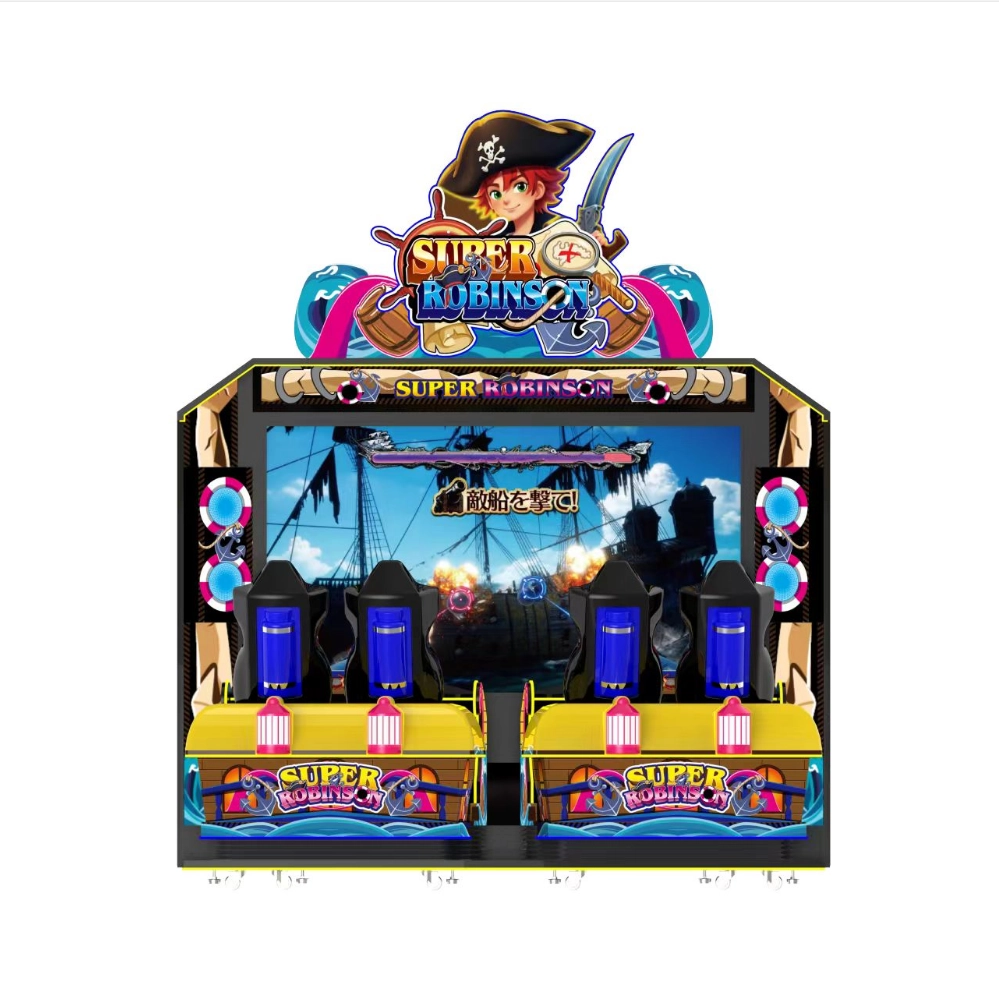
Features: Screen-based games with a mounted or handheld gun. Popular for movie-themed or zombie-shooter experiences.Use-case: High footfall arcades, multiplayer competitive zones.Pros: Attractive visuals, easy to update software; strong group draw.Cons: Sensitive to calibration; some older light-gun tech struggles on modern flat panels.
2. Ticket Redemption Shooters
Features: Simple aiming games with ticket payouts based on score. Often family-friendly and shorter session times.Use-case: FECs focusing on prize redemption and repeat revenue.Pros: Predictable earnings model; appeals to young families.Cons: Lower per-play price; requires ticket handling and redemption area.
3. Mechanical / Carnival‑Style Shooters
Features: Physical targets or moving parts. Durable and tactile; often themed for kids.Use-case: Theme parks, outdoor arcades, carnivals.Pros: Very durable; less dependence on screens.Cons: Can require more maintenance on moving parts.
4. VR & Mixed‑Reality Shooters
Features: Immersive headsets, tracked controllers, dynamic environments.Use-case: High Quality entertainment areas, VR arcades, experiential zones.Pros: High perceived value; can command High Quality pricing per session.Cons: Higher CAPEX and hygiene/rotation concerns; needs frequent software updates.
5. Skill‑Based Competitive Shooters
Features: Leaderboards, tournaments, and persistent scoring. Designed to build repeat players and communities.Use-case: Arcades running leagues, bars, or venues targeting older demographics.Pros: Drives repeat visits and higher ARPU (average revenue per user).Cons: Requires management of leaderboards and potentially networked systems.
Key Decision Criteria — How to Judge a Shooting Arcade Machine
When evaluating shooting arcade machines for purchase, consider the following practical criteria. These indicators determine both short-term satisfaction and long-term profitability.
1. Revenue metrics: Throughput, house edge, and ticket economics
Look at average session length (seconds per play), number of players per session, and ticket payout rates (for redemption games). Higher throughput and optimized payout curves increase gross revenue. Ask vendors for real-world metrics or field performance data.
2. Reliability & serviceability
Check mean time between failures (MTBF) for guns and sensors, availability of spare parts, and ease of access for routine repairs. DINIBAO emphasizes “Quality is the life” — durable components and local support reduce downtime.
3. Cabinet & build quality
Sturdy cabinets with quality joysticks, gun mounts, and protective finishes prolong lifespan. For high-traffic sites, choose industrial-grade hardware over low-cost consumer parts.
4. Software flexibility and updates
Games that can be updated with new levels, difficulty adjustments, and seasonal content maintain player interest longer. Consider whether the vendor offers free updates, paid DLC, or custom content services.
5. Monetization & payment compatibility
Modern cashless integrations (NFC, QR, card readers) can increase play frequency and average spend. Ensure compatibility with your existing payment ecosystem and local regulations.
6. Space, power, and throughput requirements
Match machine footprint and required clearance to your floor plan. Larger immersive units need more power and a managed queuing system. Balance spectacle vs. floor efficiency.
7. Safety and age appropriateness
Ensure gun replicas meet local safety rules, include eye-level warnings, and are adjustable for child players if needed. VR shooters must have clear boundaries and staff supervision options.
Comparison Table: Typical Shooting Machine Types & Operator Considerations
| Type | Typical CAPEX | Maintenance Level | Best For | Average Play Time |
|---|---|---|---|---|
| Light‑Gun / Screen | Medium | Medium | Arcades, malls | 60–180 sec |
| Ticket Redemption Shooter | Low–Medium | Low | FECs, family zones | 30–90 sec |
| Mechanical / Carnival | Low–Medium | Medium–High | Parks, outdoor sites | 20–60 sec |
| VR Shooter | High | High | High Quality zones, VR centers | 5–20 min |
| Skill Competitive Shooter | Medium | Medium | Leagues, bars | 1–5 min |
Operational Tips: Maximize Revenue and Minimize Downtime
Placement and sightlines
Place shooting machines near high-traffic aisles or entrance sightlines. Ensure clear approach space and that the cabinet artwork is visible from a distance — strong theming increases impulse play.
Pricing strategies
Use differential pricing (single play vs. multi-play bundles) and consider group discounts for multiplayer shooters. For VR or High Quality shooters, consider time-based pricing (per minute/session).
Maintenance routines and spare parts
Maintain a spares kit (gun assemblies, sensors, belts, fuses). Schedule daily quick checks and weekly calibration for aim-sensitive machines. Train on-site technicians for first-response repairs.
Promotions & lifecycle management
Rotate content and run tournaments/seasonal promotions to keep machines fresh. Track KPIs such as plays per day, gross revenue per week, and downtime hours to decide when to refurbish or replace a unit.
How DINIBAO Supports Arcade Operators
DINIBAO, based in Guangzhou, has 18 years of experience manufacturing and exporting game machines. We offer one-stop purchasing solutions for arcade centers: market research, project analysis, program & theme design, cabinet manufacturing, and after-sales support. Our machines are exported to 180+ countries and installed in over 10,000 centers worldwide. Because we own an animation and software team, we can deliver custom game experiences, seasonal updates, and local language support tailored to your market.
Checklist: Questions to Ask Any Shooting Arcade Machine Vendor
- What are real-world throughput and revenue numbers from existing deployments?
- What spares are included and what’s the delivery lead time for replacement parts?
- Do you offer warranty, on-site service, or remote diagnostics?
- How easy is it to update the software and add new content or languages?
- Are cashless payment integrations available and which systems do you support?
- Can you provide references from clients in similar markets or climates?
Common Mistakes Operators Make with Shooting Arcade Machines
- Choosing the flashiest unit without checking reliability and maintenance costs.
- Ignoring local payment preferences — missing cashless options can lower plays.
- Underestimating floor space and queuing needs for multiplayer machines.
- Failing to negotiate spare-part SLAs, causing long downtimes in remote regions.
Conclusion — What You Should Know Before Buying
Shooting Arcade Machines are versatile revenue drivers when selected and operated correctly. Prioritize reliability, payment flexibility, and software update paths over purely visual appeal. Match the machine type to your audience and floor plan: redemption shooters for families, immersive VR for High Quality spenders, and competitive shooters for repeat-play communities. Work with a vendor that supports spare parts, local service, and content updates—such as DINIBAO—to protect uptime and long-term profitability.
Sources and Data References
- DINIBAO company data provided by the client (company location, years of experience, export reach, customer count). Date accessed: 2025-12-24.
- Arcade game — Wikipedia. https://en.wikipedia.org/wiki/Arcade_game. Accessed: 2025-12-24.
- Location-based entertainment market — Allied Market Research. https://www.alliedmarketresearch.com/location-based-entertainment-market. Accessed: 2025-12-24.
- Industry articles and trade coverage on arcade and VR resurgence, compiled from trade press and operator case studies (various publishers). Accessed: 2025-12-24.
Note: For site-specific revenue estimations and machine recommendations, contact DINIBAO for a tailored market analysis and floor-plan proposal.
FAQ
What is the best type of shooting arcade machine for a family entertainment center?For family entertainment centers, ticket redemption shooters and light‑gun screen shooters designed with family-friendly themes typically perform best. They offer short play times, straightforward rules, and predictable ticket economics that appeal to children and parents.
How much floor space does a typical shooting arcade machine require?Compact redemption shooters can fit in a 1.2m x 1.5m footprint, while immersive light‑gun cabinets and VR units may require 2–4 meters of clearance to allow for comfortable play and queuing. Always confirm vendor specs and add aisle clearance for safety.
Are modern shooting machines compatible with cashless payments?Yes. Most new shooting machines support cashless options (NFC, QR codes, mobile wallets, or card readers). Cashless increases convenience and can boost average spend. Verify integration with your venue’s payment ecosystem.
What are typical maintenance costs for shooting arcade machines?Maintenance costs vary by type. Simple redemption shooters have lower maintenance (periodic target replacement and ticket printers), while VR and mechanical shooters may need more frequent servicing and part replacements. A rule of thumb: budget 5–10% of machine CAPEX annually for maintenance, higher for VR and high-throughput units.
How do I balance ticket payouts to ensure profitability?Use data: monitor average score distribution and adjust payout curves to keep the house edge predictable. Vendors that provide tuning tools or managed payout profiles can help maintain consistent ticket economics without alienating players.
Can shooting arcade machines be customized for branding or local markets?Yes. Manufacturers like DINIBAO offer custom artwork, language localization, themed content, and even bespoke game modes to fit local cultural preferences and marketing campaigns. Customization can increase appeal but may require longer lead times.
How long is the expected lifecycle of a quality shooting arcade machine?A well-built machine with proper maintenance commonly lasts 5–10 years in commercial settings. Lifecycle depends on build quality, usage intensity, and availability of replacement parts.
What safety considerations should I take when placing shooting machines?Ensure clear sightlines, supervised play for children, non-replica or clearly safe gun designs where required by local law, and physical barriers for high-velocity projectiles (if any). For VR shooters, define play boundaries and sanitize headsets between sessions.
Does DINIBAO provide after-sales service internationally?DINIBAO has exported machines to 180+ countries and offers worldwide dealer networks and overseas branches in regions like India, Chile, Thailand, Vietnam, Turkey, and the UK. Contact DINIBAO for specific service-level agreements in your region.
How can I test a shooting arcade machine before purchase?Request demo videos, on-site trials if local, or short-term rental for performance validation. Ask the vendor for real-world KPIs from reference installations and a parts/repair SLA to manage risk.

Immersive Dual-Seat Drift Experience: Extreme-Speed Whirlwind Motion Racing Game
Top 10 arcade prize machines manufacturers and suppliers
Venue layout: best placement for maximum playtime and visibility
Installation & Maintenance Guide for Racing Arcade Machines
Questions you may concerned about
Air hockey machine
Does the machine have a scoring system?
Yes. Most air hockey arcade machines feature a digital LED scoreboard that automatically tracks points for each player.
Monster Smash
Does Monster Smash require special installation or setup?
No, it is easy to install and comes with clear instructions. If needed, our technical support team can assist with the setup.
Space Guard
Is it profitable for operators?
Yes. The quick, exciting gameplay encourages repeat plays and increases ticket redemption activity.
Cupid's Arrow
Can the game be customized with my logo?
Yes, we offer full customization options, including logo placement, machine name design, and acrylic panel customization.

Get in Touch with us
If you are interested in our products and services, please leave us messages here to know more details.
We will reply as soon as possible.

 Scan QR Code
Youtube
Guangzhou DiniBao Animation Technology Co., Ltd
Guangzhou Dinibao Animation Technology Company Co., Ltd