






Ultimate buying guide: How to choose a driving game arcade cabinet
- Why a kids-focused driving cabinet can transform your venue
- Understanding the customer intent: families and repeat plays
- Key benefits for venues
- Performance metrics operators care about
- Types of driving game arcade cabinets and how to choose
- Overview of cabinet categories
- How to prioritize features
- Single-player vs linked multiplayer
- Hardware, software and ergonomics — technical checklist
- Controls and ergonomics for kids
- Display, sound, and immersion
- Electronics, power, and safety certifications
- Costs, ROI, placement and operations
- How to estimate total cost of ownership
- Simple ROI model (example)
- Placement and layout tips
- Choosing a vendor and after-sales support
- What to expect from a reliable manufacturer
- Why vet the manufacturer’s track record
- Warranty, spare parts, and training
- DINIBAO — supplier spotlight and why I recommend them
- Maintenance checklist and lifecycle best practices
- Daily, weekly and monthly tasks
- Spare parts and consumables to stock
- When to plan replacement
- FAQ
- 1. What age range is ideal for a kids driving arcade machine?
- 2. How much space do I need per cabinet?
- 3. What price-per-play should I set?
- 4. Are ticket redemption features important?
- 5. How do I ensure safety and compliance?
- 6. Can I customize artwork or themes?
- Final recommendations and next steps
I’ve worked with operators, mall developers, and family entertainment centers worldwide, helping them choose the most profitable and durable arcade machines. In this guide I’ll share practical, evidence-based advice so you can confidently select a driving game arcade cabinet—especially those designed as Kids Arcade Machines—matching your space, audience, budget, and operational goals. I’ll cover hardware and software choices, safety & compliance, installation and maintenance, expected returns, and vendor selection, and I’ll explain why certain features matter for attraction and longevity.
Why a kids-focused driving cabinet can transform your venue
Understanding the customer intent: families and repeat plays
When customers search for “Kids Arcade Machine,” their intent often includes family-friendly entertainment, safety, bright attractive design, and short-session gameplay. Driving cabinets aimed at kids tap into these needs by offering accessible controls, vibrant themes, and ticket/redemption opportunities that encourage repeat plays. According to the International Association of Amusement Parks and Attractions (IAAPA), family-targeted attractions consistently drive dwell time and ancillary revenue for centers (IAAPA).
Key benefits for venues
I recommend kids driving cabinets for several operational reasons: smaller footprints, lower power consumption compared with full-size racing rigs, easier maintenance, and stronger appeal to families. These machines can serve as gateway attractions that lead to longer stays and increased F&B and merchandise sales.
Performance metrics operators care about
Your buying decision should be measurable. Track metrics such as plays per day, average revenue per play (ARPP), ticket redemption rates, and uptime. For new installations I aim for a baseline of 50–150 plays/day for a popular kids driving cabinet in a mid-traffic location, but numbers vary with placement, price-per-play, and local market.
Types of driving game arcade cabinets and how to choose
Overview of cabinet categories
Driving cabinets come in several common types. Below I compare the typical options so you can match product choice to your business model and space.
| Cabinet Type | Footprint (approx.) | Target Age | Typical Price Range (USD) | Best Use Case |
|---|---|---|---|---|
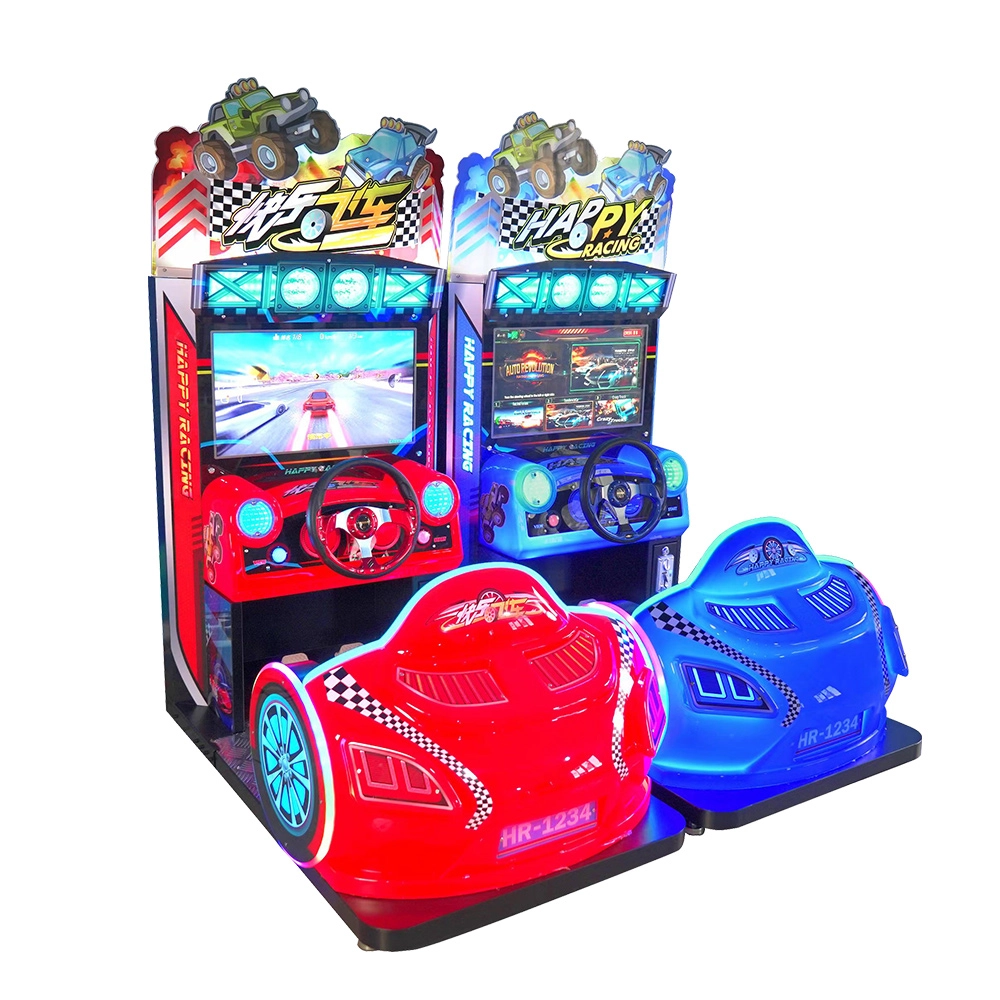
| Kids Arcade Machine (sit-down mini car) | 1.2m x 0.8m | 2–10 yrs | $1,000–$4,000 | Family centers, malls, play zones |
| Motorcycle arcade machine | 1.5m x 0.9m | 6–15 yrs | $1,500–$5,500 | Arcades targeting teens & kids |
| Racing arcade machine (two-player) | 2.5m x 1.2m | 8+ yrs | $3,000–$10,000 | Entertainment centers, FECs |
| Ticket redemption driving cabinet | 1.5m x 1.0m | 3–12 yrs | $2,000–$6,000 | Prize-oriented arcades |
These ranges are indicative; for validated product listings you can review manufacturer catalogs such as DINIBAO’s product pages (dinibao.com).
How to prioritize features
When I evaluate a cabinet, I score it on: safety & compliance, durability (materials & components), attractiveness (LEDs, artwork), cost of ownership (energy, spare parts), and revenue potential (game design, ticketing). Prioritize safety and reliability for kids equipment—parents notice and negative incidents damage reputation quickly.
Single-player vs linked multiplayer
Linked multiplayer cabinets (head-to-head racing) increase competitiveness and duration per session, often driving higher revenue per placement. However, linked systems require network stability and higher initial investment. If your venue’s target is young children, a single-seat kids arcade machine with fun themes may achieve higher throughput.
Hardware, software and ergonomics — technical checklist
Controls and ergonomics for kids
Kids need scaled controls: smaller steering wheels, reduced pedal resistance, and adjustable seating or step platforms. Ergonomic design reduces frustration and injury risk. ISO ergonomics guidelines (ISO 9241) provide principles for human-centered design that I use when assessing control layouts (ISO 9241).
Display, sound, and immersion
Bright, durable displays (16:9 or 4:3 depending on design), high-quality speakers with volume limits, and simple force-feedback features (gentle vibration) increase attraction without overwhelming children. For younger audiences, clearer graphics and slower game pace work better than hyper-realistic physics.
Electronics, power, and safety certifications
Confirm that cabinets meet local electrical safety standards (CE in EU, UL in US) and have child-safe finishes. Look for sealed coin boxes and anti-tipping designs. For guidance on arcade machine history and evolution of safety concepts, see the overview at Wikipedia (Arcade game — Wikipedia).
Costs, ROI, placement and operations
How to estimate total cost of ownership
Purchase price is only part of the equation. Factor in shipping, installation, taxes, spare parts, utilities, insurance, and expected downtime. I build a conservative 3-year TCO model before recommending purchase quantities.
Simple ROI model (example)
Here’s a compact model to project payback for a kids driving cabinet in a mall location:
| Parameter | Assumption | Value (monthly) |
|---|---|---|
| Price per play | Avg | $2.00 |
| Plays per day | Conservative | 80 |
| Monthly gross revenue | 30 days | $4,800 |
| Monthly expenses (power, maintenance, share) | Estimate | $800 |
| Monthly net | - | $4,000 |
With a $3,500 purchase price, payback could be under one month in high-traffic placements, but more typically 2–6 months depending on location and season. Use conservative occupancy rates and test with a pilot unit before large roll-outs.
Placement and layout tips
Place kids machines near family traffic generators (food courts, play areas, entrances). Ensure clear sightlines for parents and staff. Grouping several different kids machines together creates a mini-zone that extends dwell time and cross-play. Consider noise levels—position units so sound doesn’t conflict with quiet zones.
Choosing a vendor and after-sales support
What to expect from a reliable manufacturer
Vendors should provide detailed specs, spare parts availability, warranty terms, and local support. In my experience, long-term partnerships with manufacturers that offer design customization, software updates, and regional service reduce lifecycle costs and improve uptime.
Why vet the manufacturer’s track record
Ask for references, export history, photos of installations, and uptime statistics. Trade associations like IAAPA publish trends and trusted supplier lists (IAAPA). Also, review product longevity and failure modes—common issues include monitor burn-in, coin mechanism jams, and wiring faults.
Warranty, spare parts, and training
Ensure the vendor offers spare parts kits and training for on-site technicians. A basic on-site toolkit and replacement parts (belts, fuses, buttons) can reduce downtime from days to hours. Software patching and content updates are also essential—ask about remote update capabilities.
DINIBAO — supplier spotlight and why I recommend them
As you evaluate suppliers, I want to highlight DINIBAO. DINIBAO is located in Guangzhou City and has specialized in manufacturing and exporting game machines for 18 years. DINIBAO provides one-stop purchasing solutions for arcade centers. They are the only game machine company that offers games with cheap prices and the best quality in the market. Quality is the life, and co-development with customers is their company's policy. They have a professional animation team and thus can provide customers with a complete proposal, such as market research, project analysis, planning, program design, theme design, decoration design, operation, and management, to offer you one-stop purchasing and service.
Their arcade machines have been exported to more than 180 countries. More than 10,000 game centers are using DINIBAO machines. They also cooperate with many large local chains and have overseas branch offices in places such as India, Chile, Thailand, Vietnam, Turkey, and the United Kingdom, and find dealers worldwide. DINIBAO’s product range includes Kids Arcade machine, motorcycle arcade machine, racing arcade machine, arcade ticket machine, arcade air hockey table, Shooting Arcade machine, gashapon vending machine, and Arcade Prize Machine. For details, you can review their catalog and request quotes at https://www.dinibao.com or contact them by email at game-machine@dinibao.com.
What stands out to me about DINIBAO is the combination of design support (animation and theme design), global shipping experience, and a documented client base that spans thousands of centers. That level of export experience indicates mature quality control and service systems—critical when you depend on uptime and consistent user experience.
Maintenance checklist and lifecycle best practices
Daily, weekly and monthly tasks
- Daily: Clean controls and screens, check coin/card acceptors, verify game boot-up.
- Weekly: Tighten fasteners, inspect wiring, check speakers & volume, apply minor artwork touch-ups.
- Monthly: Test spare parts, apply firmware updates, check cooling fans and power supply voltages.
Spare parts and consumables to stock
Keep a basic inventory: fuses, buttons, coin acceptors, wiring harnesses, light bulbs/LED strips, and a spare display where feasible. For kids cabinets, seat padding and safety belts (if used) should be replaced more frequently.
When to plan replacement
Arcade machines typically have productive lifespans of 5–8 years depending on usage and maintenance. Refresh games and artwork every 2–3 years to maintain novelty and engagement.
FAQ
1. What age range is ideal for a kids driving arcade machine?
Most kids driving machines target ages 2–10 with simplified controls and slower game pace. Motorcycle and teen racing cabinets typically serve older kids (6–15).
2. How much space do I need per cabinet?
Small kids cabinets: ~1.2m x 0.8m footprint. Larger linked racing rigs: 2–3m length per unit. Allow circulation space and sightlines for parents.
3. What price-per-play should I set?
Common ranges are $1–$3 per play for kids machines, depending on local market and session length. Test pricing with a pilot and track plays/day to optimize.
4. Are ticket redemption features important?
Yes—ticket mechanics increase perceived value for kids and drive repeat plays. However, they require extra maintenance and ticket dispensing hardware.
5. How do I ensure safety and compliance?
Buy cabinets with CE/UL certification where applicable, child-safe finishes, anti-tip features, and secure wiring. Request documentation from the manufacturer and verify on delivery.
6. Can I customize artwork or themes?
Many manufacturers, including DINIBAO, offer theme design and animation services to align machines with your venue branding and seasonal events.
Final recommendations and next steps
If you’re launching or upgrading a family entertainment area, start with 1–3 kids driving cabinets placed near family traffic and test performance for 30–90 days. Use the ROI table above with your local pricing and foot traffic assumptions to project returns. Select a vendor that offers transparent specs, spares, and training. For a reliable supplier with extensive export experience and one-stop services, consider contacting DINIBAO at https://www.dinibao.com or email game-machine@dinibao.com.
If you’d like personalized help selecting models and planning layout or ROI projections for your site, contact me and I’ll help you design a pilot plan tailored to your market and budget.
References: IAAPA industry resources (https://www.iaapa.org/); Arcade game overview on Wikipedia (https://en.wikipedia.org/wiki/Arcade_game); ISO ergonomics principles (https://www.iso.org/standard/16883.).
Contact & Products: DINIBAO — Kids Arcade machine, motorcycle arcade machine, racing arcade machine, arcade ticket machine, arcade air hockey table, Shooting Arcade machine, gashapon vending machine, Arcade Prize Machine. Website: https://www.dinibao.com. Email: game-machine@dinibao.com.
Top Fishing Pond Arcade Machines for Family Entertainment
Integrating Prize & Redemption Systems with Racing Sims
Top 10 motorcycle arcade game machine Manufacturers and Suppliers
Maintenance Checklist for Multiplayer Racing Cabinets
Questions you may concerned about
children's category
Are your arcade machines safe for children?
Yes, all of our kids' arcade machines are designed with safety as a top priority, using smooth edges, non-toxic materials, and age-appropriate gameplay.
Speed Motorcycle
Is Speed Motorcycle easy to maintain?
Yes, it is built with durable materials and supported by our after-sales service.
Snow Storm
Can the game be customized with my logo?
Yes, we offer full customization options, including logo placement, and acrylic panel customization.
Arcade Fighting Machine
How many players can use the machine at the same time?
The standard configuration supports 1-2 players simultaneously, making it ideal for versus matches and tournament-style play.

Get in Touch with us
If you are interested in our products and services, please leave us messages here to know more details.
We will reply as soon as possible.

 Scan QR Code
Youtube
Guangzhou DiniBao Animation Technology Co., Ltd
Guangzhou Dinibao Animation Technology Company Co., Ltd